
Thursday, December 16, 2010
Skirt Full of Stars - Motion reactive skirt with fiber optics
Imagine a skirt that sparkles with a rainbow of colors as you walk, dance, and twirl. The Skirt Full of Stars is an interactive, illuminated garment using the LilyPad Arduino platform, designed to respond to and accentuate the movements of its wearer.
 http://www.instructables.com/id/Skirt-Full-of-Stars-Motion-reactive-skirt-with-f/

e-Textile Workshop Sells Out at the Record Breaking Grace Hopper Celebration 2010

 |
| A conductive tape star is born! |
 |
| Gotta love buttons! |
The panel and workshop was led by Ann-Marie Horcher from Nova Southeastern University, and myself which included a presentation on the importance of e-Textiles within the computing community ... then the fun began ... circuit building in a wide array of personal objects. The workshop ran smoothly with everyone helping out, talking about designs, how to complete the circuit in their project and everyone left with a working circuit. A fantastic workshop for a celebration of fascinating women!!
 |
| Yahoooo...it lit!! |
Friday, December 10, 2010
Modkit Visits Bloomington!

 |
| Modkit uses a Scratch like interface |
 | ||
| The immediate feedback was a huge hit! |
After playing with the Modkit for several days, the youth planned out the designs for their LilyPad projects. Projects included a series of LEDs in a hat that would light in a rotating manner, a backpack that would light and play music when the backpack was worn, a purse with blinking & solid lit LEDs, another purse with rotating LEDs on a flower design and another purse that used the temperature sensor to change the lights behavior.
 |
| Solid and Flashing LEDs! |
 |
| Warm = Flashing LEDs |
 |
| Cold = Solid LEDs |
Fall e-Textiles at the Boys and Girls Club

This fall semester saw some new projects completed at the Boys and Girls Club in Bloomington due to a new group of club members. Every Monday and Wednesday the youth attended the e-Textile Club to work on projects. The biggest hit of the season were the Halloween buckets and bags! Youths first designed parallel circuits on paper, then using traditional LEDs to sew circuits using curled LEDs typically for the eyes. (Many are excellent LED curlers now : -)


Tuesday, December 7, 2010
Book: Sewing School: 21 sewing projects kids will love to make
As we work with youth in elementary school, we're finding many don't have the basic sewing skills or knowledge about sewing, materials and procedures.
 This is where the book Sewing School can help. It nicely lays out many sewing basics from beginning to end like tying a knot, to threading a needle, various stitches, materials, about sewing in groups, using patterns (and includes patterns) and showcases youth aged 6-13 through out the book.
Additionally, Sewing School shows a number of simple projects that could be made and are being made by youth. One of the strongest components of the book are the quotes from the youth, especially if youth will be looking through it for guidance...they'll see how much someone else enjoyed it and feel that they can also complete the project.
This is the look-inside link at amazon: http://www.amazon.com/Sewing-

Additionally, Sewing School shows a number of simple projects that could be made and are being made by youth. One of the strongest components of the book are the quotes from the youth, especially if youth will be looking through it for guidance...they'll see how much someone else enjoyed it and feel that they can also complete the project.
This is the look-inside link at amazon: http://www.amazon.com/Sewing-
NSF Webcast Highlights E-Textiles and MIT's High-Low Tech Team

Press Release 10-230
NSF Celebrates Computer Science Education Week 2010

NSF Celebrates Computer Science Education Week 2010
NSF CELEBRATES COMPUTER SCIENCE EDUCATION WEEK 2010
NSF-funded programs like GLITCH and E-Textiles make it cool to compute and may inspire the next Bill Gates
NSF-funded programs like GLITCH and E-Textiles make it cool to compute and may inspire the next Bill Gates


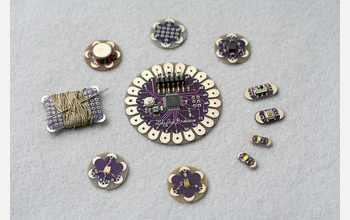 Credit and Larger Version |
View a webcast highlighting two NSF programs that engage students in computer science.
Imagine a jacket that lights up. With directional arrows programmed into the fabric, a bicyclist can use her jacket to alert traffic when she's turning. The jacket is an example of e-textiles, a techology that is drawing more girls to computer science through an innovative program at MIT. Meanwhile at Georgia Tech, high school students are hired to test and debug computer games, a way of bringing diverse students to computer science.
These inspired programs are unfortunately not typical. American information technology and software companies dominate the world marketplace, yet there is a gaping hole in formal computer science education. For K-12 students, computer science education is practically nonexistent. The United States lacks an adequate pipeline to feed world class computer science at the university level with the number and diversity of students needed to address societal challenges.
To recognize the critical role of computing and computer science education in the 21st century, Congress declared Dec. 5-11, 2010, as Computer Science Education Week (CSEdWeek).
In a Dec. 7 webcast, the National Science Foundation (NSF) highlighted two NSF-funded programs that aim to fill this gap and engage populations of students not typically drawn to computer science.
Amy Bruckman of Georgia Tech, along with Ph.D. candidate Betsy DiSilvo and former student James Bowland-Gleason, describes GLITCH, the Georgia Tech program that uses video games as a way for the high school students to "break open" the games and look at them as a piece of technology.
Leah Buechley and Emily Lovell of MIT's Media Lab report on their success at the forefront of teaching information technologies to the next generation of female computer scientists. They discuss how their High-Low Tech research group explores the integration of high and low technology from cultural, material, and practical perspectives to engage diverse groups of people in developing their own technologies. E-Textiles at MIT, for example, has captured the imagination and honed the computational skills of girls.
CSEdWeek representative Cameron Wilson of the Association for Computer Machinery provides perspective on why this week is important to his industry and to America's competitive edge. Other countries have stepped up their efforts with computer science education, and several countries, including Canada, Israel, New Zealand, Australia and some Asian countries have implemented a comprehensive computer science curriculum.
The notion that only future computer scientists or information technology (IT) professionals need training in computer science is no longer true. Outside of the IT industry, knowledge of computer science and computer programming is becoming a necessary skill for many professions, including those in science and technology, as well as careers in marketing, advertising, journalism and the creative arts.
-NSF-
For full posting see: http://www.nsf.gov/news/news_summ.jsp?cntn_id=118192&org=NSF&preview=false
For full posting see: http://www.nsf.gov/news/news_summ.jsp?cntn_id=118192&org=NSF&preview=false
Friday, December 3, 2010
Circuit Quilt Premiers at the Annual Boys & Girls Club Art Show
Tonight was the opening of the annual BGC Art Show at the Bloomington City Hall. Over 50 pieces of art were shown and it was also the unvailing of the Circuit Quilt, which included 16 circuit quilt squares made by youth who attended the Creativity Labs summer workshop.
 The quilt project was met with enthusiasm by everyone at the art show as they entered the front door. As parents, children and teachers interacted with the quilt, they were amazed that the squares lit up! Children wanted to make another one this summer, parents wanted their children in the current e-textile club and workshops and there was a real buzz about the combination of science and the arts!
Additionally, there was a lot of excitement about the bracelets the e-textiles club is currently making at the BGC as well. Unfortunately, we are in the last week of the club before the holidays, but I have a feeling many will be requesting the return of the bracelet in the upcoming spring semester. Several mothers even commented to their child that they wanted one for themselves for the holidays! (See the LilyPond for instructions on the bracelets)
 The quilt is still undergoing it's finishing touches: like embroidering on the green trim, and having the youth at the club add yarn ties to the square intersections. After a short display in our offices, the quilt will be presented to the club to hang an a wall where the children can easily press the push button switches to light up each circuit.
I wanted to add a special thanks to Kara, our lab assistant, who really came through in getting the quilt to this point so quickly for the art show. Also thanks to our summer workshop circuit team: Aviyona, Clay, Ethan, Gabriel, Griffin, Justin, Lennon, Luca, Makayla, Melisha, Phoebe, Rakia, Ron, Sage, Samari and Stephanie for making their first sewn circuits so beautifully!

 |
| Matisse, the BGC Art Director, and myself display the quilt |

I wanted to add a special thanks to Kara, our lab assistant, who really came through in getting the quilt to this point so quickly for the art show. Also thanks to our summer workshop circuit team: Aviyona, Clay, Ethan, Gabriel, Griffin, Justin, Lennon, Luca, Makayla, Melisha, Phoebe, Rakia, Ron, Sage, Samari and Stephanie for making their first sewn circuits so beautifully!
Monday, November 15, 2010
Electronic Craft Bags

Toting the myriad supply of needles, conductive thread, LEDs, alligator clips, and so on, then distributing it amongst kids' table and toting it back later can be a big pill to say the least. So we bought these bags thanks to a facebook ad that was actually relevant.
 Here are scissors, Lilypads, alligator clips, fashion paint, velcro strips, a mini iron, USB drives, conductive thread, and tape all throw together in one bag. And what do we do with the LEDs?
Look at this delight! Six round trays with 6 snap down slots for stowing batteries LEDs. We simply plop two sets on each table and the kids have access to what they need. And it's relatively easy to clean up. We're *really* going to appreciate this when we start using the red, yellow, green, blue, and white LEDs in combo...
(Bags are by Creative Options and I think we ordered them through AC Moore.)
Sunday, November 14, 2010
"Arts & Crafts" Materiality in (and out of) Digital Games
This is from Sara Grime's blog -- please go there for videos etc. Sara also presented on this topic at the DIY Critical Citizenship conference in Toronto, November 2011

This week Nintendo released it's newest installment of the Kirby series, Kirby's Epic Yarn. What piqued my interest about the game is its use of arts & crafts as an aesthetic motif - everything looks like it's made of string, buttons, yarn and zippers. The aesthetic is supplemented by some clever looking game mechanics, which add to the sense of materiality and texture introduced by the game's environments and imagery. For instance, backgrounds contain loose threads that can be pulled, and things made of yarn (including Kirby himself) can change shape. I should add in a disclaimer at this point that this description is based on a cursory review of the demo videos (such as the one I've posted below) and early reviews - I haven't actually played it yet:
©2010 Nintendo, Inc., Kirby Epic Yarn promo materials
This week Nintendo released it's newest installment of the Kirby series, Kirby's Epic Yarn. What piqued my interest about the game is its use of arts & crafts as an aesthetic motif - everything looks like it's made of string, buttons, yarn and zippers. The aesthetic is supplemented by some clever looking game mechanics, which add to the sense of materiality and texture introduced by the game's environments and imagery. For instance, backgrounds contain loose threads that can be pulled, and things made of yarn (including Kirby himself) can change shape. I should add in a disclaimer at this point that this description is based on a cursory review of the demo videos (such as the one I've posted below) and early reviews - I haven't actually played it yet:
Of course, this immediately reminded me of LittleBigPlanet, which obviously also applies an "arts & crafts" aesthetic, albeit in a significantly (i.e. stylistically) distinct way. But as I thought about it a little more, I started to list all the other games I've come across that "play" with materiality, textiles and crafts, and realized that there is a small but notable genre emerging here. Nintendo itself has applied a similar "material" or "arts & crafts" aesthetic to a number of games in the past - most notably in the Paper Mario games, but also in the cardboard cut-out environments of Yoshi's Story:
Games like Crayon Physics, And Yet It Moves and Okami might also be included on this list, though more on the arts aspect than crafts. From Majesco, we now have Crafting Mama for the NDS. And there must be just about a million "girl games" or "pink games" that incorporate crafting to some degree - though I suspect this is predominantly in the form of mini-games, rather than on an aesthetic dimension. Searching for more examples, I came across this website for KNiiTTiiNG!!, a game that uses the Wii to simulate and teach knitting. Apparently, the game is still in Beta, but it got some media coverage last year (e.g. Kotaku), and is currently being featured as part of an art exhibit at the San Jose Museum of Quilts and Textiles. Again - not quite what I have in mind when I'm thinking of materiality and an "arts & crafts aesthetic" - but worth mentioning nonetheless.
All of which leads me back to the other side of this burgeoning relationship between arts & crafts, materiality and videogames, which manifests as physical objects, crafts, embroidery, etc., that reify (reproduce, remediate?) elements and characters from videogames. Aldo Tolino calls these "ludic artifacts": player-created objects that are inspired by video games, but created outside of the games themselves. Oftentimes, these objects aim to transport game themes or characters into the physical world, thereby extending the game experience into other areas of cultural experience & fan practice.
Gaming community members have long engaged in these practices, which include everything from knitting Metroid Prime dolls, to dressing up asPacman characters and running around the city, to baking the Portalcake (based on a recipe included in the game as an Easter Egg). For Tolino, one of the most important features of "ludic artifacts" is that they are quite often shared online - through pictures, videos, and other digital artifacts - with other members of the game community. There are also online communities that have formed around particular forms of "ludic artifact" production. An example of this is Sprite Stitch, a blog and forum dedicated to "videogame inspired crafts" and the people who make them. The forum community includes over 1200 knitters, embroiderers and other craftmakers who exchange pictures, patterns and advice about making videogame characters into tangible objects. One of the things that interests me most about these practices is how frequently they combine traditionally feminine (or do I mean feminized) craftwork with videogame fandom - baking, knitting, sewing, carpentry and metalworking. The transfer from digital to material and back to digital again (as the objects are photographed and filmed to be shared online) is simply fascinating.
More Examples:
- Kirby Epic Yarn Plush on Instructables
- LittleBigPlanet Sackboy Knit Pattern
- AP's list of Video Game themed Crochet & Knit Patterns
- Gaming's Non-Digital Predecessors, by Laurie N. Taylor and Cathlena Martin, University of Florida (International Digital Media & Arts Association Journal, v.1, no.3, SPring 2005, pp.25-9)
Sunday, November 7, 2010
Amy Sedaris offers a how-to book with a wacky twist

Cross Martha Stewart and Groucho Marx, add a dash of Lenny Bruce and a heaping dose of LSD, and you get America's most maniacal domestic diva - Amy Sedaris, author of the magisterial how-to book Simple Times: Crafts for Poor People.
Sedaris' 304-page tome, which she cowrote with Paul Dinello, is a copiously illustrated, funny, tongue-in-cheek idea book for making some of the most out-of-this-world, creepy - albeit cute - handmade home knickknacks in recent memory.
But she wasn't always known as the busy homemaker's patron saint.
A comedian, film star, author, and sister of humorist David Sedaris (a terrific career achievement), she is best known as the creator and star of Comedy Central's surreal comedy of ill manners, Strangers With Candy.
In 2006, she rocked and shocked the best-seller list with I Like You: Hospitality Under the Influence, a 304-page (whoa!), post-Martha Stewart guide to throwing the baddest (you know, that's baaad as in cool) parties.
Her crafting book, which she will discuss Friday night at the Free Library, includes such simple-to-make, affordable items as the "unable to make ends meet belt" (rolled plastic wrap); "poor man's toffee" (heated and futher-condensed condensed milk); "tampon ghosts" (just add wings); the Dropout Crab Claw Roach Clip (a roach clip stuck to the non-pincer side of a claw saved from dinner); and an entire series of "Crafting for Jesus" crafts, including Moses' Comb Holder, Jesus Sandals, a matchbook cross, and a clothespin Jesus.
Read more: http://www.philly.com/philly/entertainment/20101105_Amy_Sedaris_offers_a_how-to_book_with_a_wacky_twist.html#ixzz14dZ3lVcT
Watch sports videos you won't find anywhere else
Subscribe to:
Posts (Atom)


 Posts
Posts


