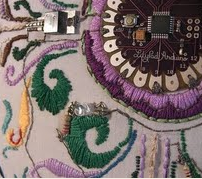
Fascinating documentary by Rodrigo Calvo and Raúl Alaejos about Arduino open source software and how it came to be, along with the development of the boards into what is now a blooming field of opportunity for beginners. No doubt you'll be familiar with some of the players interviewed...including David Mellis, graduate student in Leah Buechley's MIT High Low Tech Lab!
View the 28 minute documentary at: http://gizmodo.com/5734025/everything-worth-knowing-about-arduino
The documentary is also available at Vimeo (EN, ES) and it can be download from Archive.org (EN, ES). The file is licensed under CC-SA 3.0 and can be redistributed.
Showing posts with label Technology. Show all posts
Friday, January 14, 2011
Sunday, January 31, 2010
Imogen Heap's Twitter dress Tweets from the Grammy's
Los Angeles, February 01, 2010

Singer-songwriter Imogen Heap hands down won, although unofficially, the 52nd Grammy Awards' wearing a "Twitter Dress," a piece of clothing which instead of showing sexy skin, had images transmitted by fans who utilized the hashtag #twitdress.
One of the early social media hat tips in evidence comes from artist Imogen Heap, who accepted an award for Best Engineered Album, Non-Classical wearing a specially crafted “Twitter Dress.”
Around Heap's neck: a kind of sculptural cuff with blinking light. And her purse was a small television.
The necklace had a live Twitter feed with a wireless router. And a television with videos her fans were sending to her account. She brought her followers down the red carpet.
The Twitdress idea is nothing if not a creative way to incorporate social media into the Grammys experience and — literally — bring the fans with an artist onto the stage.
http://www.hindustantimes.com/Imogen-Heap-s--Twitter-dress-Tweets-from-the-Grammy-s/H1-Article1-503953.aspx

Singer-songwriter Imogen Heap hands down won, although unofficially, the 52nd Grammy Awards' wearing a "Twitter Dress," a piece of clothing which instead of showing sexy skin, had images transmitted by fans who utilized the hashtag #twitdress.
One of the early social media hat tips in evidence comes from artist Imogen Heap, who accepted an award for Best Engineered Album, Non-Classical wearing a specially crafted “Twitter Dress.”
Around Heap's neck: a kind of sculptural cuff with blinking light. And her purse was a small television.
The necklace had a live Twitter feed with a wireless router. And a television with videos her fans were sending to her account. She brought her followers down the red carpet.
The Twitdress idea is nothing if not a creative way to incorporate social media into the Grammys experience and — literally — bring the fans with an artist onto the stage.
http://www.hindustantimes.com/Imogen-Heap-s--Twitter-dress-Tweets-from-the-Grammy-s/H1-Article1-503953.aspx
Tuesday, January 26, 2010
Blast from the Past… IU Computational Textile Workshop 10/24/09
Several months ago Leah Buechley, director of the High-Low Tech Group at the MIT Media Lab, and techie dream team (Emily Lovell and Hannah Perner-Wilson) visited the Indiana University campus in Bloomington to give an hour long presentation to a packed house in the Fine Arts Auditorium. The well received presentation was followed by an over-capacity, five-hour-long circuit and LilyPad workshop. This event has kicked off immense interest in the CT/DIY movement. Following are a few of the highlights from the day-long event.
Part 1: Leading off the hour long presentation was a video of an electronic pop-up book http://www.youtube.com/watch?v=AI-6wMlaVTc&feature=player_embedded, Leah lit the path to the new emerging possibilities of technology. The book was built with a kit which allowed the designer/builder to create their own electronic vision of an interactive object, that empowerment is the focus of the MIT High-Low Tech Group. But to reach that point, Leah pointed out that technology, including creative technology, must be democratized. Traditionally that might happen through lowering the hurdle, that is making it easier to write computer programs or to work with electronics, however this approach excludes many things at the heart of democratization. (Leah projects a photo of a quilting circle that could have included my late Grandmother) Ahhh…we all get it…the exclusion factor!
But not only is it the exclusion of participants but also the exclusion of materials (when was the last time you saw a Lego Mindstorm kit made with textiles?) So Leah’s groups approach to technology democratization is to change up the material assumptions and where it belongs and what it looks like. Leah went on to explain “we think that if you change the materials, then you change the material context and very naturally change the culture context and thereby shift the culture around technology.” A video of Leah’s bike turn signal jacket played center stage http://www.instructables.com/id/turn-signal-biking-jacket/, proof of the previous point, but to drive it further she explained about the series of workshops she implemented. Including the history of the LilyPad (hand made to manufactured) and discussed some of her favorite projects made with the LilyPad.
Next Hannah discussed a pre MIT LilyPad project called the Puppeteer Project with the use of pressure and bend sensors in performance clothing http://www.kobakant.at/index.php?menu=2&work=2, while emphasizing how changing materials can also change what the technology looks like. Then Emily talked about the new tool kit developed for conductive paint http://hlt.media.mit.edu/paper_computing/index.html and a magnetic surface, which opens the door for even more paper, based products like Hannah’s electronic paper keyboard.
In conclusion, there seems to be a cultural definition of technology (this can be suggested by the lack of females in fields of engineering and computer programming) and there is room to grow. There is a need to expand our cultural assumptions on what technology looks like and who participates. This is where the LilyPad comes into play, but first we need a lesson on circuitry (see Part 2).
Part 1: Leading off the hour long presentation was a video of an electronic pop-up book http://www.youtube.com/watch?v=AI-6wMlaVTc&feature=player_embedded, Leah lit the path to the new emerging possibilities of technology. The book was built with a kit which allowed the designer/builder to create their own electronic vision of an interactive object, that empowerment is the focus of the MIT High-Low Tech Group. But to reach that point, Leah pointed out that technology, including creative technology, must be democratized. Traditionally that might happen through lowering the hurdle, that is making it easier to write computer programs or to work with electronics, however this approach excludes many things at the heart of democratization. (Leah projects a photo of a quilting circle that could have included my late Grandmother) Ahhh…we all get it…the exclusion factor!
But not only is it the exclusion of participants but also the exclusion of materials (when was the last time you saw a Lego Mindstorm kit made with textiles?) So Leah’s groups approach to technology democratization is to change up the material assumptions and where it belongs and what it looks like. Leah went on to explain “we think that if you change the materials, then you change the material context and very naturally change the culture context and thereby shift the culture around technology.” A video of Leah’s bike turn signal jacket played center stage http://www.instructables.com/id/turn-signal-biking-jacket/, proof of the previous point, but to drive it further she explained about the series of workshops she implemented. Including the history of the LilyPad (hand made to manufactured) and discussed some of her favorite projects made with the LilyPad.
Next Hannah discussed a pre MIT LilyPad project called the Puppeteer Project with the use of pressure and bend sensors in performance clothing http://www.kobakant.at/index.php?menu=2&work=2, while emphasizing how changing materials can also change what the technology looks like. Then Emily talked about the new tool kit developed for conductive paint http://hlt.media.mit.edu/paper_computing/index.html and a magnetic surface, which opens the door for even more paper, based products like Hannah’s electronic paper keyboard.
In conclusion, there seems to be a cultural definition of technology (this can be suggested by the lack of females in fields of engineering and computer programming) and there is room to grow. There is a need to expand our cultural assumptions on what technology looks like and who participates. This is where the LilyPad comes into play, but first we need a lesson on circuitry (see Part 2).
Labels:
Buechley,
computational textile,
democratization,
Events,
IU,
MIT,
Technology
E-Textiles: Moving Beyond the Screen
Join us in the lobby for a fun, hands-on workshop, run by Kylie Peppler at the Indiana Celebration of Women in Computing (WIC), Friday Feb 5th. Everyone will create their own e-textile by merging sewing, crafts, and electronics to create a wearable circuit.
Participants are asked to bring their own artifact to be enriched with wearable circuits to the workshop. A shirt, jacket, hat, or any other fabricated object that can be sewn is suitable and will make your experience more meaningful. All other materials will be provided.
Artifacts like colorful interactive dresses and programmable paper sketchbooks confound our assumptions about the look and feel of technology. When we put technology in unusual material and cultural contexts like these, it becomes appealing to new and diverse groups of people. In this workshop, we examine aspects of computation and design that dovetail with hands-on crafts, physical construction and design, and material play. As today's notions of "electronic media" are expanding beyond the screen, we need to consider how engagement with digital media can encompass electronic textiles, "smart" or controllable materials, fabricated artifacts, and computationally-enriched physical objects.
See entire article at: http://www.cs.indiana.edu/inwic/fun.html
Participants are asked to bring their own artifact to be enriched with wearable circuits to the workshop. A shirt, jacket, hat, or any other fabricated object that can be sewn is suitable and will make your experience more meaningful. All other materials will be provided.
Artifacts like colorful interactive dresses and programmable paper sketchbooks confound our assumptions about the look and feel of technology. When we put technology in unusual material and cultural contexts like these, it becomes appealing to new and diverse groups of people. In this workshop, we examine aspects of computation and design that dovetail with hands-on crafts, physical construction and design, and material play. As today's notions of "electronic media" are expanding beyond the screen, we need to consider how engagement with digital media can encompass electronic textiles, "smart" or controllable materials, fabricated artifacts, and computationally-enriched physical objects.
See entire article at: http://www.cs.indiana.edu/inwic/fun.html
Subscribe to:
Posts (Atom)