Several months ago Leah Buechley, director of the High-Low Tech Group at the MIT Media Lab, and techie dream team (Emily Lovell and Hannah Perner-Wilson) visited the Indiana University campus in Bloomington to give an hour long presentation to a packed house in the Fine Arts Auditorium. The well received presentation was followed by an over-capacity, five-hour-long circuit and LilyPad workshop. This event has kicked off immense interest in the CT/DIY movement. Following are a few of the highlights from the day-long event.
Part 1: Leading off the hour long presentation was a video of an electronic pop-up book http://www.youtube.com/watch?v=AI-6wMlaVTc&feature=player_embedded, Leah lit the path to the new emerging possibilities of technology. The book was built with a kit which allowed the designer/builder to create their own electronic vision of an interactive object, that empowerment is the focus of the MIT High-Low Tech Group. But to reach that point, Leah pointed out that technology, including creative technology, must be democratized. Traditionally that might happen through lowering the hurdle, that is making it easier to write computer programs or to work with electronics, however this approach excludes many things at the heart of democratization. (Leah projects a photo of a quilting circle that could have included my late Grandmother) Ahhh…we all get it…the exclusion factor!
But not only is it the exclusion of participants but also the exclusion of materials (when was the last time you saw a Lego Mindstorm kit made with textiles?) So Leah’s groups approach to technology democratization is to change up the material assumptions and where it belongs and what it looks like. Leah went on to explain “we think that if you change the materials, then you change the material context and very naturally change the culture context and thereby shift the culture around technology.” A video of Leah’s bike turn signal jacket played center stage http://www.instructables.com/id/turn-signal-biking-jacket/, proof of the previous point, but to drive it further she explained about the series of workshops she implemented. Including the history of the LilyPad (hand made to manufactured) and discussed some of her favorite projects made with the LilyPad.
Next Hannah discussed a pre MIT LilyPad project called the Puppeteer Project with the use of pressure and bend sensors in performance clothing http://www.kobakant.at/index.php?menu=2&work=2, while emphasizing how changing materials can also change what the technology looks like. Then Emily talked about the new tool kit developed for conductive paint http://hlt.media.mit.edu/paper_computing/index.html and a magnetic surface, which opens the door for even more paper, based products like Hannah’s electronic paper keyboard.
In conclusion, there seems to be a cultural definition of technology (this can be suggested by the lack of females in fields of engineering and computer programming) and there is room to grow. There is a need to expand our cultural assumptions on what technology looks like and who participates. This is where the LilyPad comes into play, but first we need a lesson on circuitry (see Part 2).
Showing posts with label MIT. Show all posts
Showing posts with label MIT. Show all posts
Tuesday, January 26, 2010

Tuesday, January 19, 2010
Specialty Fabrics Review reports on NSF Grant
Specialty Fabrics Review
January 2010
Creating computational textiles
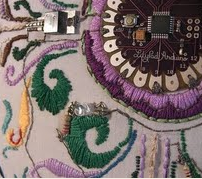
It’s called a LilyPad Arduino, and designer Leah Buechley and a team of educators and scientists plan to show more than 400 students how to combine it with traditional fabric arts to create computational textiles—computers embedded into fabrics. Buechley, director of the “High-Low Tech Group” at the Massachusetts Institute of Technology (MIT) Media Lab, developed the LilyPad Arduino microcontroller board, which has electronic parts that can be sewn onto clothing to project light, produce sound or perform other technical operations.
The National Science Foundation provided a three-year grant to bring scientists and art educators from Indiana University, MIT and the University of Pennsylvania together to blend learning and creativity. The grant team will bring aspects of physics, engineering, computer programming, art, clothing design and fabrication skills into after-school educational settings. LilyPad Arduinos have been used to program built-in turn signals on a biking jacket, a sewing machine that can be used as a printer and an exhibit simulating the experience of being inside a human body.
http://specialtyfabricsreview.com/articles/0110_sw3_textiles.html
January 2010
Creating computational textiles
It’s called a LilyPad Arduino, and designer Leah Buechley and a team of educators and scientists plan to show more than 400 students how to combine it with traditional fabric arts to create computational textiles—computers embedded into fabrics. Buechley, director of the “High-Low Tech Group” at the Massachusetts Institute of Technology (MIT) Media Lab, developed the LilyPad Arduino microcontroller board, which has electronic parts that can be sewn onto clothing to project light, produce sound or perform other technical operations.
The National Science Foundation provided a three-year grant to bring scientists and art educators from Indiana University, MIT and the University of Pennsylvania together to blend learning and creativity. The grant team will bring aspects of physics, engineering, computer programming, art, clothing design and fabrication skills into after-school educational settings. LilyPad Arduinos have been used to program built-in turn signals on a biking jacket, a sewing machine that can be used as a printer and an exhibit simulating the experience of being inside a human body.
http://specialtyfabricsreview.com/articles/0110_sw3_textiles.html
Tuesday, January 5, 2010
Visiting MIT's Media Lab

Becky Stern: Today I'm visiting the Media Lab's High-Low Tech (HLT) group, headed up by Leah Buechley. I'm hanging out with her and her grad students Hannah Perner-Wilson, David Mellis, and Emily Lovell, as well as e-textile education maven Kate Hartman. More later this week including video, but for now check out mine and Kate's photos! Yesterday we met with all sorts of education and e-textile superstars and had a knitted sensor workshop. Pictured above is Hannah showing Kate how to finish her machine-knitted conductive yarn stretch sensor.
Subscribe to:
Posts (Atom)


 Posts
Posts

