
Find out more at http://www.barbie.com/videogirl/
Not sure what to make of this but had to post ...
 |
| Deja Vu front with pressure switch |
 |
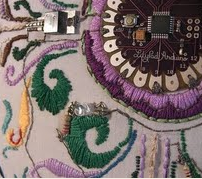
| Inside showing the LilyPad Arduino |


Sarah Kate Beaumont practicing her craft.

WALK into the modest railroad-style brownstone apartment and it feels less like Brooklyn and more like stepping off the steam train into “Little House on the Park Slope Prairie.”
Part of Ms. Beaumont's space at Very Sweet Life Studio in Brooklyn.
Elizabeth Cline studying Ms. Beaumont's work on a pillow pattern.
Floppy felt hats with broad rims gather like old friends on an antique green rack, greeting visitors at the door. Simple striped yellow, white and gray curtains adorn the front windows.
In the middle room, linen and raw-silk blankets sit with seersucker pillowcases atop cotton sheets. A white linen pinafore dress with a ruffled chiffon hem hangs in the sparse closet next to a flamenco flannel skirt and dozens of other colorful creations. T-shirts, tank tops and lingerie are folded into neat squares on small shelves, and wooden hooks hold just-worn items.
A wicker basket on the floor fills with laundry that never felt so satisfying.
Sarah Kate Beaumont sewed all of these items one by one over the past three years in what began as an experiment of self-reliance and artistic whimsy and has now blossomed into a way of life.
That life may hark back to pioneer days, but Ms. Beaumont is not homesteading alone.
Brooklyn, fiercely proud of its independence from Manhattan, is an expanding frontier for the Do It Yourself movement — resourceful residents are baking bread, raising chickens for eggs, keeping bees for honey or simply renovating brownstones themselves. Ms. Beaumont, a shy woman in her early 40s with auburn curls, settles as comfortably into that ethos as she does into her flowing dresses.
“I never intended to do it this long,” she said softly on a recent afternoon. “I think it speaks to how good it feels. Self-reliance is really empowering.”
Ms. Beaumont began sewing to live in the summer of 2008, when after eight years of teaching art in the city’s public and private schools, she decided to become a full-time artist. Her dream was to share her craft by teaching adult sewing classes. Because the timing coincided with the financial collapse, she altered the dream with common sense.
“I decided,” she said, “that I would make anything I needed.”
She started with the lingerie. A flowing skirt led to a pair of pajamas. Aprons, stuffed animals, raincoats, sheets, terry cloth towels and curtains followed. She makes everything she wears save the odd pair of jeans, socks and shoes.
Ms. Beaumont likes to call her project “Slow Clothes,” after the Slow Food movement promoting the homegrown.
Ms. Beaumont recycles material from old items or buys fabric relatively inexpensively in Manhattan in the garment district. It usually takes her two to three weeks to finish a dress, a few hours for underwear.
Two years ago, she decided to put a label on her items, “verysweetlife,” with the inscription, “Handmade in Brooklyn.” She has yet to market that label, though she says she is ready to start. There is one nagging issue: pricing.
“How do you take something that you’ve spent a tremendous amount of time and effort on and put a price on it?” she said. “Each piece is unique. That’s one thing about making everything you wear — nobody will ever be wearing what you are wearing.”
In the meantime, Ms. Beaumont supports herself with sewing classes, for which she charges $65 to $500, depending on the length of the course, and offers private lessons as well.
Tamara Mose Brown, an assistant professor of sociology at Brooklyn College, who lives in Kensington, says Ms. Beaumont exemplifies the economic growth occurring in Brooklyn, driven by small businesses, restaurants and clothing shops. “Brooklynites are feeling that they want to have this identity away from Manhattan and the air of consumerism,” Professor Brown said. “There’s this element of self-preservation and economic sustainability.”
In her intimate second-floor sewing studio in Boerum Hill, outfitted with five Kenmore sewing machines and filled with rulers, patterns and dress forms, Ms. Beaumont teaches adults — lawyers, writers, grandmothers and others — fractions, geometry and remedial cutting in order to master patternmaking.
“It is not a sign of intelligence how hard it is to cut or measure,” she assured three students working on a pillow pattern last month in her studio.
Harriet Clemons, 54, of Crown Heights, was taking the three-week course so she could make clothes for her grandchildren. Kate Clifford, 28, works at a SoHo knitting shop and wanted to expand her repertoire. One of her roommates in Kensington sells homemadevegan muffins.
Elizabeth Cline, 30, of Bedford-Stuyvesant, is writing a book about budget fashion and the declining price of clothing, and hoped to supplement her own wardrobe.
“It’s encouraging that you can actually make things that are better or at least the level of what stores are selling,” Ms. Cline said.
Ms. Beaumont never followed the crowd, growing up in Pittsburgh embroidering, and enjoying the meals made by her mother, a chef and a baker. She majored in English literature at Bryn Mawr College, where she rode a unicycle in leggings and a skirt.
Every day she kisses her sleek white high-tech Bernina sewing machine, next to which she has meticulously organized bobbins by color, and spools of thread. Although hers is an intense, solitary passion, it is also meditative, in sync with much of the D.I.Y. culture.
“It’s hands on, getting back to the basics,” Ms. Brown said, “and it makes people feel that they are not falling victim to the machine.”
Unless, of course, it’s a white Kenmore.
“These are adults who hold their pillows and beam, they are so proud of themselves,” Ms. Beaumont said with a twinkle. “That’s how I feel a lot of the time. It’s not ego-driven pride, but I look in the mirror and say, ‘I can do this.’ ”

“LOST ON THE STREETS OF NEW YORK, A CROCHET GIRL MUST DECIDE
WHAT’S REAL BEFORE HER CROCHET WORLD UNRAVELS.”
YARNANA is an explosive narrative film, featuring the “Crochet Madness” of New York artist, Olek. Inspired by the silent film genre, it relies solely on powerful music, sound design and physical expression. The characters speak through modern dance, physical comedy, capoeira, martial arts, poi, belly dancing, breakdance, acrobatics, gymnastics and the instincts of soul searchers.
YARNANA is 20 minutes of romance and adventure where traditional storytelling becomes unraveled...
http://vimeo.com/25110105
 CACM, October 2010
Personal fabrication
Open source 3D printers could herald the start of a new industrial revolution.
While AttenDinG A health and beauty trade show in the fall of 2009, Nick Starno watched as countless exhibitors
struggled with cosmetic tubes, vainly at- tempting to squeeze the last few drops out of them. Starno, however, is a me- chanical design engineer, and familiar with 3D printers. When he got home, he designed a tube squeezer and posted his prototype on a community Web site for 3D printer designs. Within hours, several 3D printer enthusiasts in Europe had downloaded his design and manu- factured the tube squeezer. Since then, Starno’s design has been downloaded more than 500 times and people around the world have produced his tube squeezer at a cost about 30 cents each.
“I knew that as long as I could model it on the computer, it could be made,” says Starno, who now works with Mak- erbot, a 3D printer company. “No worry- ing about tooling costs, post processing, surface finishes, packaging, shipping quantities, or advertising. Anyone with a 3D printer could search for my design, download it, and make one on demand without ever leaving their house.”
Printing simple devices such as tube squeezers might not seem very excit- ing or sexy, but it heralds the begin- ning of a technological revolution in- volving thousands of hobbyists around the world who are using 3D printers to fabricate wine glasses, toy cars, cooling fans, mechanical arms, and countless types of nuts, bolts, and gears.
To many observers, this revolution mirrors the personal computer revo- lution, with its kits for hobbyists, of the 1970s. “There are many parallels between personal computing and per- sonal fabrication,” says Hod Lipson, an associate professor of mechanical and aerospace engineering and computing and information science at Cornell Uni- versity. “I think you can look at the histo- ry of computers and how they changed our world, and you can anticipate many
nick Starno, a mechanical design engineer, in the process of building a 3D printer.
aspects of 3D printing and how they will interface with every aspect of our lives.”
open Source Printers
While large-scale, commercial 3D print- ers have existed for years, personal 3D printers are a recent, fast-spreading phe- nomenon. Dozens of startup companies are developing and marketing 3D print- ers, but two of the most widely used 3D printers are open source projects.
Based at the University of Bath, Rep- Rap is the brainchild of Adrian Bowyer, a senior lecturer in the department of me- chanical engineering. The other project is Fab@Home, which is led by Lipson.
To design a printable object, a user needs a computer equipped with a com- puter-assisted design (CAD) program. The different RepRap and Fab@Home 3D printers are the size of a standard office photocopier, and feature off-the- shelf components including a chas- sis, tool heads, and electronics. The 3D printers work almost the same as a
standard printer, but instead of using multi-colored inks, a printer’s mobile arm includes a syringe that ejects melt- ed plastic, slowly building up the “im- age,” layer after layer, into a real object. Simple objects like a gear, for instance, can be completed in less than an hour.
The parts for the latest RepRap print- er, Mendel, cost about $525, but an online network of artists and inventors are constantly modifying and improv- ing Mendel’s design. Moreover, Mendel prints about 50% of its own parts, ex- cluding nuts and bolts, so it is almost a self-replicating machine.
“It’s designed to copy itself because that’s the most efficient way of getting a large number of them out there,” says Bowyer, who estimates more than 4,000 RepRap printers have been made since the plans for the original RepRap Dar- win printer were first released in 2008. “If you’ve got something that copies it- self, then, in principle, the numbers can grow exponentially fast, and that’s fast-
14 communicationS of the acm | OcTOber 2010 | VOL. 53 | nO. 10
PhotograPh by bre Pettiser than any other means of production that humanity currently has.”
new Design frontiers
In addition to enabling people to manu- facture objects they never could before, 3D printers could lead to radically new designs that are not possible with tra- ditional fabrication techniques. “Your first instinct when you have one of these machines is that instead of making something in the machine shop, you are just going to print it,” says Lipson. “But at some point you realize you can make new things with complicated geometry that you cannot make any other way. You don’t have to stick to straight edges and flat surfaces that can be easily ma- chined or thin walls that can be injec- tion molded. You can make absolutely any shape that you want.”
For instance, Lipson’s team has ex- perimented with printing objects with both hard and soft materials. When the materials are printed at a random 50%- 50% ratio, the results are ordinary. How- ever, when the dots of hard and soft ma- terial are printed in special patterns, the material, when stretched like an elastic, actually gets thicker.
Indeed, one of Lipson’s favorite 3D printer materials is Play-Doh. He re- cently used it to create miniature copies of the U.S. space shuttle during a school visit as part of the Fab@School project, led by himself and Glen Bull, a professor of instructional technology at the Uni- versity of Virginia. The Fab@School’s goal is to use 3D printers to show K–12
Crowdsourcing
students the combined power of math, science, and engineering. The MacAr- thur Foundation and Motorola have awarded $435,000 to the Fab@School group to develop curriculum, build more 3D printers, and expand the project.
a Larger ink Palette
Although Play-Doh and other squishy substances can be used in 3D printers, melted plastic remains the primary material. Other desirable materials, in- cluding various metals and ceramics, are more challenging to use. Progress has been made in printing with metal, but more experimentation is needed to make the process easier and overcome fundamental properties in the materi- als like melting point and viscosity.
For Lipson’s Fab@Home project, the ultimate goal is to design a robot that can walk out of the printer. Before that can happen, “inks” for batteries, actua- tors, wires, transistors, and numerous other pieces must be developed. How- ever, Lipson’s lab has already developed an actuator that operates with low volt- age and a printable battery.
Adrian Bowyer at the University of Bath has had success making a print- able conductor that melts at a lower temperature than the plastic does. Due to the temperature difference, the 3D printer can manufacture plastic chan- nels that do not melt when filled with the hot conductor for wires or other electrical circuitry.
“At the moment the way we manu- facture goods is from economies of
scale,” says Bowyer. “It is more efficient to make lots of one thing in one place and that’s how conventional industry works all over the world. But there are many things we used to do that way that we don’t do anymore. For instance, I’m old enough to remember my parents getting personalized letterhead printed at a local printer, whereas now we have computer printers. Imagine the idea of a whole industry disappearing, and ev- erybody making what they want in their own home. That would be a pretty pro- found economic change.”
Further Reading
Bradshaw, S., Bowyer, A., and Haufe, P.
The intellectual property implications of low-cost 3D printing. SCRIPTed 7, 1, April 2010.
Hiller, J. and Lipson, H.
Design and analysis of digital materials for physical 3D voxel printing. Rapid Prototyping Journal 15, 2, 2009.
Malone, E. and Lipson, H.
Fab@home: the personal desktop fabricator kit. Rapid Prototyping Journal 13, 4, 2007.
Sells, E., Smith, Z., Bailard, S., Bowyer, A., and Olliver, V. RepRap: the replicating rapid prototype: maximizing customizability by breeding the means of production. Handbook of Research in Mass Customization and Personalization, Piller, F.T. and Tseng, M.M. (Eds.), World Scientific Publishing Company, Singapore, 2009.
Graeme Stemp-Morlock is a science writer based in elora, ontario, canada.

A class on historic gastronomy at the Brooklyn Brainery, which offers cheap, low-commitment classes on a variety of topics, like tying knots.

In a zippy demo at TED U, AnnMarie Thomas shows how two different kinds of homemade play dough can be used to demonstrate electrical properties -- by lighting up LEDs, spinning motors, and turning little kids into circuit designers.
 |
| LilyPad/fiber optic design created for Anna Reutinger’s fashion line - GMA |


 Posts
All Comments
Posts
All Comments


