Monday, November 2, 2009

Sound Reactive Garment


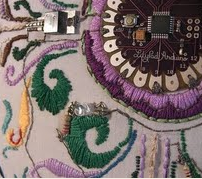
The nightgown reacts to high voice levels and was made as a result of the 56 day performance. The nightgown illustrates increased sensitivity within the relationship.


The gown was made with the Lilypad Arduino, flexinol, microphone, and 2 relay switches.


Korean Computing Technology Show 2009

The Next Generation Computing Technology Show 2009 presented state-of-art Korean IT Technology under the theme "IT RE*connect." Featured technologies of human computing, cloud computing, and green computing demonstrated a fantastic performance with harmony among humanity, technology, and nature. This will provide a new message for future generations.


For full story go to: http://www.koreaittimes.com/story/5454/clothes-e-textile-materials

LilyPad Layout


Drag components to explore potential circuit layout for the LilyPad Arduino (and related components). Make connections between components by clicking on a hole in a circuit board and dragging to a hole in another board.

Sunday, November 1, 2009

LilyPad w/servo motor

So it's not a wearable, but in seeking how servo motors functions, puppets popped up, which could be a wearable. So with that in mind, take a peak at what this LilyPad design looks like and could function as.

Thursday, October 29, 2009

Magnetic Source

Leah recommends ordering magnets from: http://www.kjmagnetics.com/categories.asp


Ring magnets can be used with fabric. These can also be sewn or riveted in fabric or bolted or screwed into a solid material. Another form of magnet attachment includes sewing conductive fabric into a pouch then drop a magnet into that pouch. A clasp magnet (like used in jewelry) is another type that could be attached by sewing onto fabric.
Note: K&J magnets are extremely strong.

Happiness Hat 2009

A wearable conditioning device that detects if you're smiling and provides pain feedback if you're not. Frowning creates intense pain but a full smile leaves you pain free! The first in a series of Tools for Improved Social Inter-Acting.


A smile is a simple action that has the power to make you and everyone around you feel better. Just using the muscles to smile can make you feel happier. Seeing someone else smiling triggers mirror neurons in your own brain, causing you to unconsciously smile yourself. What is the potential of feedback to improve the way we act and feel? On the other hand, how often does the appearance we project misrepresent what we are really thinking and feeling? How do we reconcile these ideas?

Build your own Loopin


Hannah told us about this great kit to build a Happy or Grumpy Loopin:

The educational textile electronics toy developed for ZippyKit includes everything you need to build your own 'Loopin'.

The finished creature's eyes light up when their smart soft ears are touched together, or to the ears of another Loopin. The kit can be configured in one of two ways, so that you can have two characters in one! Make the happy or the grumpy Loopin as many times as you wish while learning the circuitry.
Loopin provides a fun and accessible introduction to electronics, for both boys and girls, and is also a great, hands-on craft project, to be enjoyed by all the family.

Comes in a variety of colours, and you can also choose your own.
http://www.lostvalues.com/boutique/loopin-by-zippykit.html

Thursday, October 22, 2009

How will technological artifacts impact society?


Speaker: Leah Buechley
High-Low Tech Group Director, MIT Media Lab

Professor Buechley will discuss how traditional arts and crafts combined with new technologies can be used to empower students, hobbyists, artists and educators to explore new domains and spark new creative communities.

Saturday, October 24th @ 10 - 11am
Indiana University Bloomington
School of Fine Arts, Room 102

Sponsored by a grant from the National Science Foundation (NSF-0855886) to Prof. Kylie A. Peppler, School of Education, and in coordination with Prof. Leslie Sharpe, Henry Radford Hope School of Fine Arts, IU Bloomington.
For more information, please contact kpeppler@indiana.edu.

See SOE Press Release for additional information: http://newsinfo.iu.edu/news/page/normal/12264.html

Wednesday, October 21, 2009

Journals on Creativity Research

Check these out:
+ Journal of Creative Behavior (the oldest journal on creativity research)
+ Creativity Research Journal (one of the leading research journals)
+ Psychology of Aesthetics, Creativity, and the Arts (a new, APA journal that has been publishing some provocative pieces)
+ Digital Creativity

Free Online Circuit Simulation Software


Nichole Pinkard of DePaul University in Chicago has begun to use a set of fun, interactive, research-based simulations of physical phenomena from the PhET project at the University of Colorado with her students to investigate electrical circuits.

Check it out at:
http://phet.colorado.edu/index.php