Showing posts with label Resources. Show all posts

Tuesday, March 23, 2010

Win the Know-It-All Bag parts from SparkFun!!


SparkFun and Knitty.com has joined up for a contest to give away the LilyPad Arduino parts to make your own Know-it-all Bag! Just blog how you would use the Know-it-all Bag. But hurry...the contest ends March 26th! http://knitty.com/blog/?p=131

Wednesday, March 10, 2010

Embedded EL wire & more materials to sample


Here's a fun site for EL wire embedded in knit or textile and EL wire in EL tape http://www.plugandwear.com/products.htmlThey sell the inverters also.

Plug & Wear also has pressure sensitive fabric and pressure sensitive fabric tape. And they stock some different conductive fabric: like single side conductive laminate made of aluminum foil, knitted superlight conductive fabric, Velostat and other goodies http://www.plugandwear.com/products2.html
Check the bottom of the page to order a sample kit.


Tuesday, March 9, 2010

Bee Puppet - Bee Sim Interactive Game

The Bee puppet is part of an interactive game for children learning about hive activity of bees, including pollination, by playing the role of the bee. The bee puppet sits velcroed on top of the glove hiding the main board, x-bee and LiPower. Three LEDs are sewn into the glove exposed on a finger (represents the flower pollen strength). The battery is hidden inside the bee body cavity sewn onto plastic mesh to help form the body shape.

The RGB sensor (game ticking clock) & 3 additional LEDs (represents bee pollen gathered) were sewn first sewn directly onto the puppet for the first prototype. However, it was quickly seen that total access was needed to the boards below the puppet, therefore the second iteration had the RGB sensor and LEDs sewn onto felt buttons, then buttoned through the bee cavity onto the bee neck and abdomen (glass beads were used to insulate the conductive thread) This design was chosen to not only allow easy access for repairs, but also to allow the glove to be interchanged with other insect puppets to examine their activity habits.

During the Bee Sim game the child/bee interacts with flowers, some with conductive material with a variety of hidden resistors beneath the felt flower center and some without conductive material (representing no pollen). After the child gathers the pollen they must return to the beehive before their energy runs out (as represented on the RGB sensor) where the pollen is dropped off and recorded/accumulated by the computer hive through the use of the xbee.

Friday, March 5, 2010

Friday, January 29, 2010

Sunday, December 6, 2009

NYTimes Article on the Future of Craft


December 3, 2009
For Crafters, the Gift of Automation
By PETER WAYNER

THE easy replication enabled by the digital era is coming to the tactile world, and one of its first stops is the two-dimensional world of paper, felt and vinyl. Computer-driven styluses can cut, burnish and emboss paper and other materials using instructions purchased or swapped on the Web.

Such automation may seem at odds with the concept of handmade, but there’s no doubt the tools allow for bigger and more elaborate projects that might cause cramps if cut manually.

Jennifer McGuire, an artist in Cincinnati, plans to make 150 Christmas cards using her Silhouette digital cutter to make hundreds of snowflakes in slightly different sizes. Then, she said, she will glue them together in layers, place a family picture in the center and add a loop so the snowflake can hang on a tree.

“In the past, I’ve cut some myself by hand,” she said, “and that takes way too long.”

The cutting machines look and manipulate paper like printers for personal computers but have blades instead of ink cartridges. They started appearing more than four years ago, and the earliest versions used patterns from cartridges and digital memory cards. This year, the manufacturers have enabled customers to buy patterns from professional artists and are making it easier for crafters to swap patterns through online networks.

Besides making cards, crafters use the machines for scrapbook projects, home décor, lettering and artwork. Here are three machines often mentioned by crafters:

PAZZLES

Jeremy Vander Woude, the general manager of Pazzles, based in Boise, Idaho, said his company was finishing tests of the Pazzles Craft Room, a Web site that borrows ideas from members of social networks and adapts them to support Pazzles machines. Customers will be able look at the creations of other crafters and download plans to replicate them. Some features will be free, and some sections, like the collection of professionally designed projects, will be available for a fee.

With the Pazzles cutter, “you can use any fonts, you can design your own images, you can take public domain clip art, turn it into line drawings that can then be cut,” Mr. Vander Woude said. “If they’re having a bit of trouble making their project work just right, they can get on the Internet and chat with one of our designers.”

The machines cost $600 for the basic model and up to $3,000 for professional models intended for heavy use.

CRICUT

The Cricut line from Provo Craft in Spanish Fork, Utah, includes machines that can be used with or without a home computer. Jon Lee, brand director for the line, said customers typically liked the simplicity of purchasing and using a collection of cutting patterns on a cartridge without having to understand software or computers.

In the past, Provo Craft sold patterns on cartridges that might include several hundred designs with a similar theme; it hopes to expand its online offerings and triple the number of cartridges available next year. Designs include a variety of original and licensed outlines, including popular cartoon characters like Batman and SpongeBob SquarePants.

The basic machine costs $149, and the Cricut Expression, which can handle 12- by 24-inch paper, is $349. The company also makes a hand-held tool called the Gypsy that is used to choose fonts and shapes to be cut. It lists at $300.

Mr. Lee said Cricut’s Internet-based tools might offer individual patterns to customers for a particular project, but he declined to provide details. One small company, Craft Edge, sells a $90 software package that has fonts and outlines that can be cut on the Cricut machine.

SILHOUETTE

This line of digital cutters uses the iTunes model to sell individual patterns on the Internet, said Kirk Pead, the vice president for sales and marketing at Silhouette America in Lindon, Utah, adding, “We started getting third-party artists to give us images, and they’ll be paid royalties based on how many times they’re downloaded.”

Once owned by QuicKutz, a company that makes tools for crafters, Silhouette has been spun off on its own. The company recently announced that it was licensing patterns from Hero Arts, a company that makes rubber stamps, and Mr. Pead promised more to come.

THE Silhouette SD costs $300 and includes a $25 gift card for patterns from its online store. Pattern prices usually start at $1.99, with an unlimited subscription for $30 a month.

Erin Lincoln, a member of the Silhouette Design Team in Boonsboro, Md., said she had used the machine to cut patterns for etching glass, create spider cutouts for Halloween and make hundreds of stars to decorate her son’s wagon for Memorial Day.

“I like the fact that it looks manufactured,” she explained. “I don’t like the stuff looking hokey-crafty. I want the stuff to look as professional as possible. I don’t want uneven lines or edges.”

http://www.nytimes.com/2009/12/03/technology/personaltech/03CRAFTS.html

Monday, November 2, 2009

From the Daily Pennsylvanian

Professor makes clothes light up

The idea of stitching circuitry into clothing may seem like a concept gleaned from the pages of a science-fiction novel set centuries into the future.

However, Yasmin Kafai of the Graduate School of Education — along with researchers from the Massachusetts Institute of Technology Media Lab and Indiana University — intends to do just that in an effort to cultivate interest in programming among youth.

The team received an $800,000 grant, titled “Computational Textiles as Materials for Creativity,” from the National Science Foundation in August to help its members realize this objective.

Kafai, the lead project investigator, explained that computational textiles, also known as “electronic” textiles, are soft materials with electronics — like sensors and light dials — and computer programs embedded in them.

“Nowadays, you have conductive thread that looks exactly like regular thread. You can actually stitch your circuits and combine the sensors with the light as embroidery,” she elaborated, adding that the process of fitting textiles with circuitry comprised the “engineering” element of the project.

The “computation” element lies in utilizing the LilyPad Arduino, an electronic textile construction kit, to hook the sensors and lights in the textiles up to a computer program with a USB cable. Once the programming is complete, it can then be determined how these textile components will interact with the environment.

“You can essentially illuminate the display on your clothes or on your bags, wherever you have it,” Kafai said. “You can put the electronics anywhere and use the conductive thread to create circuits and decorations — that’s the ‘creative’ part.”

Once the team receives clearance from the City of Philadelphia to work with students, it will hold after-school workshops at William H. Hunter Elementary School, the Penn Alexander School and the Science Leadership Academy.

During workshop sessions, students will design computational textile creations to share and discuss through Scratch, a web site Kafai designed while working at MIT. The site enables users to design programs and upload them to share with others, who will then provide feedback.

Kafai added that, as the project progresses, she hopes to work with teachers on integrating programming activities into their regular daytime curriculum as well.

The project coincides with Congress’s recent passage of resolution H. RES. 558, which urged “educators and policymakers to improve computer science learning at all educational levels, and to motivate increased participation in computer science,” according to a statement issued by the Association for Computing Machinery.

This national focus on expanding computer science education is likewise reflected in the NSF’s “Broadening Participation in Computing” initiative.

According to Kafai, the number of women and minorities interested in pursuing computer science degrees and careers has been consistently low over the last 10 years.

“That’s why there's a need to come up with innovative ways, particularly for youth, to demonstrate that programming isn’t just sitting in front of a computer screen in your room,” she said, “but has applications that connect you with the real world and your particular interests.”

Wednesday, October 21, 2009

Journals on Creativity Research

Check these out:
+ Journal of Creative Behavior (the oldest journal on creativity research)
+ Creativity Research Journal (one of the leading research journals)
+ Psychology of Aesthetics, Creativity, and the Arts (a new, APA journal that has been publishing some provocative pieces)
+ Digital Creativity

Sunday, October 4, 2009

A Book Wish List for CT Enthusiasts

Banzi, M. (2008). Getting started with arduino. Sebastopol, CA: Make:Books/O’Reilly Media, Inc.

Braddock Clark, S.E. & O’Mahony, M. (2008). Techno textiles 2: Revolutionary fabrics for fashion and design. London: Thames & Hudson.

Buechley, L. (2006). LED clothing. Make a programmable tank top. CRAFT Magazine, Journal of Architectural Design. Vol. 1. pp 54. http://web.media.mit.edu/~leah/grad_work/diy/diy_tank.html.

Eng, D. (2009). Fashion geek: Clothes accessories tech. Cincinnati, OH: North Light Books.

Frauenfelder, M. (2007). The best of MAKE. Sebastopol, CA: Make:Books/O’Reilly Media, Inc.

Gschwandtner , S & Shirobayashi, K. (2007). KnitKnit: Profiles + projects from knitting's new wave. New York, NY: Stewart, Tabori & Chang/Harry N. Abrams, Inc.

Igoe, T. ( 2007). Making things talk: Practical methods for connecting physical objects. Sebastopol, CA: Make:Books/O’Reilly Media, Inc.

Igoe, T. & O’Sullivan, D. (2004). Physical computing: Sensing and controlling the physical world with computers. Boston, MA: Thomson Course Technology PTR.

Lewis, A & Lin, F. (2008). Switch craft: Battery-powered crafts to make and sew. New York, NY: Random House.

McQuaid, M. (2005). Extreme textiles: Designing for high performance. New York, NY: Princeton Architectural Press.

Pakhchyan, S. (2008). Fashioning technology: A DIY intro to smart crafting. Sebastopol, CA: Make:Books/O’Reilly Media, Inc.

Reas, C. & Fry, B, (2007). Processing: A programming handbook for visual designers and artists. Cambridge, MA: The MIT Press.

Seymour, S. (2008). Fashionable technology: The intersection of design, fashion, science, and technology. New York, NY: Springer-Verlag/Wien.

Sunday, August 23, 2009

READY MADE Magazine


Here's another DIY magazine covering a wide range of home, fashion, food and other projects -- definitely more focused on the hip crowd. The blog contains projects from all the past issues -- check out Sew! and Plug it in!

Monday, August 17, 2009

Green Craft Magazine and blog

While at the Barnes & Nobles newsstand I cam across a magazine called Green Craft which also has a blog. It's a new bi-annual publication which features a wide range of projects with recyclable materials. It's a bit Martha Steward-like photographed, but showcases how plastic bags, old t-shirts can be turned into stylish artifacts. The blog has planet of 'how-to' examples and might be good place to get patterns and guides for free.


Sunday, August 16, 2009

MAKE magazine

Do I need to say more? Check out Make magzine and associated blog.

CRAFT Magazine

To follow up on the search of print magazines that serve today's DIY crowd, there is of course one promising candidate: the Craft magazine and associated blog.

Saturday, August 15, 2009

DIY Magazines newstand -- 100 Idées


Today I spent some time browsing print magazines at Barnes & Noble newsstand to see what's available in the DIY aisle. Well, there is quite a bit on quilting, crocheting, scrapbooking, beads, sewing, knitting, and so on. It all seems to be aimed at a particular audience, more adult, kind of Good Housekeeping gone wild. I was trying in vain to find something hip, like for college students, artsy crowd - like 100 idées (see below). I suspect all of these groups are much better served by online blogs and communities.

When I lived in France in the 80's we had this really cool monthly magazine called 100 ideas -- 100 Ideés -- which really was a whole DIY movement without the technology. It stopped circulation in the late 80's but here's a website (unfortunately in French) with some pics. I actually once knitted the sweater with the clouds for someone -- believe it or not -- I still have the pattern!

Thursday, July 30, 2009

DIY e-textiles library, "How to get what you want"

"This website aims to be a comprehensible, accessible and maintainable reference resource, as well as a basis for further exploration and contribution"
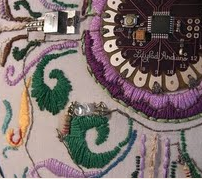
This website, "How to get what you want" was developed in large part by one of my (wonderful) incoming graduate students, Hannah Perner-Wilson.