


A button on Barbie Photo Fashion's belt is pressed to take a picture that appears on her shirt, which can then be downloaded to a computer.
Generation after generation, Monopoly money stacked up in piles of pink, green and gold, Hot Wheels raced across floors and Barbie was, well, just a doll.
On the digital version of the Game of Life, a tablet makes the old plastic spinner's sound.
Not anymore.
Classic toys are becoming much less classic because of upgrades meant to entertain technology-obsessed children. Where they once tried, unsuccessfully, to compete with digital devices, toy makers are co-opting them.
Monopoly money can now be counted by a tablet computer. Hot Wheels cars can zoom across iPad screens. And Barbie? She’s become a digital camera.
“We know that kids are going to play with technology, with iPhones and iPads and Android devices,” said Chuck Scothon, senior vice president for marketing for Mattel’s North America division. “Our job is to not necessarily avoid that, but if you can’t fix it, feature it.”
The souped-up classics reflect the growing reality that children, like their parents, are loath to spend time without their devices. More than a third of children 8 years old and younger use mobile devices like iPads or smartphones, arecent study from Common Sense Media found, and about a quarter of children ages 5 to 8 multitask with their digital devices most or some of the time.
While toy makers have tried to modernize their products for years, this is the industry’s most aggressive integration of tech.
The upgrades are also a direct response to the toy industry’s funk. Retailers are desperate for something new, and most toy makers had a disappointing 2011. In the fourth quarter, when toy companies make most of their sales for the year, sales at the two biggest companies, Hasbro and Mattel, fell by 2 percent domestically (Hasbro’s figures include Canadian revenue).
And the main item retailers could not seem to keep in stock last year was a tablet computer for children, the LeapFrog LeapPad Explorer.
“Kids like to play with the gadgets that they see their parents using, so I think it makes sense for toy makers to find a way to freshen up,” said John Alteio, director of toys and games for Amazon, which will carry several of the tech-enhanced toys.
Mr. Scothon said Mattel has studied how children spend time on various activities, including digital devices, and found that a lot of playtime was revolving around the gadgets.
So Mattel’s new Barbie has a lens in her back; children point the doll at an image, and press a button on Barbie’s belt to take a photo. The image then appears on the front of Barbie’s T-shirt. The photos can also be downloaded to a computer.
“The future of play is trending towards a seamless integration between a physical toy and digital add-ons,” said Laura Phillips, senior vice president for toys and seasonal merchandise at Walmart, in an e-mail. “This innovation is extremely important to keeping kids engaged and keeping toys more relevant.”
Toys like spy glasses and laser tag sets have been transformed. Now, because of the addition of technology that records daytime and night vision video, the spy glasses made by Jakks Pacific, called Spy Net Multi Vision Goggles, could actually perform serious surveillance. And Hasbro’s Laser Tag of yore, when children ran around and pointed toy guns at one another, has been replaced by children pointing iPhones instead. Players place the iPhone in a gun, and the iPhone display — via an app — shows live video of whatever is ahead overlaid with graphics. When the trigger is pulled, lasers appear.
Mattel is introducing a line of games called Apptivity for classic brands, including Hot Wheels, Fisher-Price and Barbie. Using free apps, children pull up a game on the iPad. But instead of using a virtual car or avatar, children move small plastic toys with sensors around the iPad.
The makeovers have extended to tech versions of board games, too. In Game of Life, the plastic spinner has been replaced by a tablet, which shows a picture of the spinner and makes the spinner’s sound. In Monopoly, a tablet or smartphone counts everyone’s money and, when a player lands on Chance or Community Chest, it starts a short digital game, replacing the cards that told people to go to jail, go directly to jail.
“While parents might want certain things, kids enjoy their mobile devices,” said Hasbro’s chief marketing officer, John Frascotti. “This allows parents not to have that confrontation with kids.”
Gadgets that make the link between the virtual and the actual world can be helpful to children, said Sandra L. Calvert, director of the Children’s Digital Media Center at Georgetown. Though children need time away from devices, “any kind of link that you can be drawing between different environments, and seeing that they’re somehow linked together, is useful,” she said.
However, given that the digitally linked games are more expensive (the Barbie with a camera, for instance, is $50, more than twice as much as a plain Barbie) and that many require expensive iPads or smartphones to work, analysts say their potential is limited.
“IPhones and iPads, while extremely popular, are still very limited in real numbers — they’re expensive, they’re adult products, and yes, kids take them and use them, but you have to ask yourself just how far they will go,” Lutz Muller, a toy analyst for Klosters Trading, said. The Common Sense study found that low-income families were unlikely to have downloaded apps for their children’s toys, for instance, which many of the new toys require.
While real-world toys are adding a virtual aspect, some companies are taking the opposite tack. Moshi Monsters, which started out as an online-only game, started selling plush toysshaped like monsters late last year.
“We don’t want a world where kids are just staring at a screen for their play constantly,” said Michael Acton Smith, chief executive of Mind Candy, which makes the toys.
RHINESTONES, sequins and gold lamé can still add traditional glitter to evening wear. But if you really want to shine at your next dinner party, consider the sparkle that a jacket with light-emitting diodes or a corsage with fiber optics could provide.

A silk top with sparkling LEDs, from Moon Berlin, offers just one example of wearable electronics. In the future, circuitry could allow a coat to display full-length videos, or for a handbag to point the way to an event, aided by GPS sensors within.
Faux-fur headphones — a do-it-yourself project from Syuzi Pakhchyan, who has written a book about electronics for clothing.
Wearable electronics are starting to dress up gowns, handbags and even tuxedos, and not just in one-of-a-kind costumes worn by the likes of Fergie, Katy Perry, Lady Gaga or other divas.
For the rest of us, designers and others are starting to offer such merchandise online — giving it bling by way of conductive thread, sensors, batteries and small microprocessors. And daytime computerized wearables are on the way, like T-shirts and coats that can show full-length videos or use GPS to point you to your destination.
Moon Berlin, a German fashion label of the company Franken & Bruns, recently opened an online shop that sells chiffon dresses with white LEDs beneath the sheer fabric. The LEDs twinkle softly at first, then shine more intensely as the wearer moves, says Christian Bruns, co-owner of Franken & Bruns. (The batteries are good for 8 or more hours. You can always turn them off if want to save power.)
Already popular on the Web site are accessories like fiber-optic brooches and LED-illuminated clutch pocketbooks. And men’s dinner jackets with a touch of LED glitter are on the way, Mr. Bruns says.
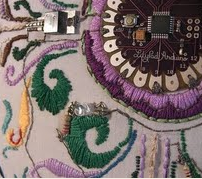
If you want to try your own hand at creating a computerized, electronic glow, Adafruit Industries, a New York company that makes and sells kits and components, will soon introduce a small, wearable microprocessor called Flora to control LEDs or other electronic adornments. Becky Stern, who leads the company’s wearable electronics group, will develop projects and kits based on it for crafters.
“Pop stars have costumes made by ateliers at huge cost,” Ms. Stern says, adding that her company’s products would “let you make these electronic wearables at home for a fraction of that.”
Electronics offer a new dimension to people who design and make clothing, says Kate Hartman, an assistant professor of wearable and mobile technology at OCAD University in Toronto.
“Designers are accustomed to working with texture, color and form,” Professor Hartman says. “But now electronics gives us another avenue of expression.”
In the last decade, the use of soft, flexible circuitry in clothing has grown as technology has improved, she says. Conductive fabric, thread or yarn, as well as microprocessors that can be sewn into cloth, can be found at Web sites like SparkFun.com.
The Flora platform from Adafruit should spur the wearable-computer movement, Professor Hartman says. “It has built into it all of the hardware needed to program,” she says, as well as the ability to link to GPS and Bluetooth, among other components.
One Flora kit, meant for a handbag, will offer a GPS sensor linked to a LED display. “You won’t have to take your cellphone out to check for directions,” says Limor Fried, an electrical engineer and founder of Adafruit. “The bag will have a big arrow to tell you which direction to go.” The kit’s price will be less than $100, not including the cost of the handbag, she says.
A future kit based on Flora will create video displays on the back of a jacket, says Phillip Torrone, a senior editor at Make magazine and creative director at Adafruit. “The display will be low-resolution at first,” he says. “But it will be recognizable as video.”
Adafruit will also develop apps for iPads, iPhones and Android devices, Ms. Fried says. Hobbyists can then make T-shirts for joggers, for instance, that include LEDs that glow red or orange when air quality is poor, with a Bluetooth connection to tweet the information to other joggers.
Syuzi Pakhchyan, who has written “Fashioning Technology,” a book about electronics for clothing, and whose Web site keeps track of wearable-computer fashions, says she thinks many hobbyists will be able to use Flora.
Even those without technical or programming backgrounds, she says, could receive step-by-step help from other users in an online community. Ms. Pakhchyan herself has created a video tutorial on how to make a faux fur set of headphones, a process she describes as “pretty addictive and super-easy.”
Professor Hartman at OCAD says that one of many benefits of adding computers to clothing may be a change in attitudes toward technology. “As people begin to be able to create with technology,” she said, “they are less afraid of it.”
Ms. Fried at Adafruit says she looks forward to a time when people will routinely modify the style of their shoes, jackets, T-shirts or handbags with circuitry. Then, she says, Bill Cunningham, the fashion photographer for The New York Times who has long roamed the streets for the latest looks, will have a new trend to cover: LED fashions.


FiberPhiladelphia |


 Posts
All Comments
Posts
All Comments


